Work and careers
How to make money with AI skills: 6 ways people get paid
Six honest ways to turn AI skills into paid work, who each one suits, how to find a first client, and how to price by the result instead of the hour.
By VibeBay team5 min read
If you can get useful work out of AI tools, you have a skill people will pay for. Not because the tools are secret. Because most businesses have no time to learn them, and no idea what to ask for.
This guide covers six ways people get paid for AI skills today. None of them is a shortcut, and we will not promise you an income. They are simply the routes that work, with the trade-offs of each.
First: sell the result, not the tool
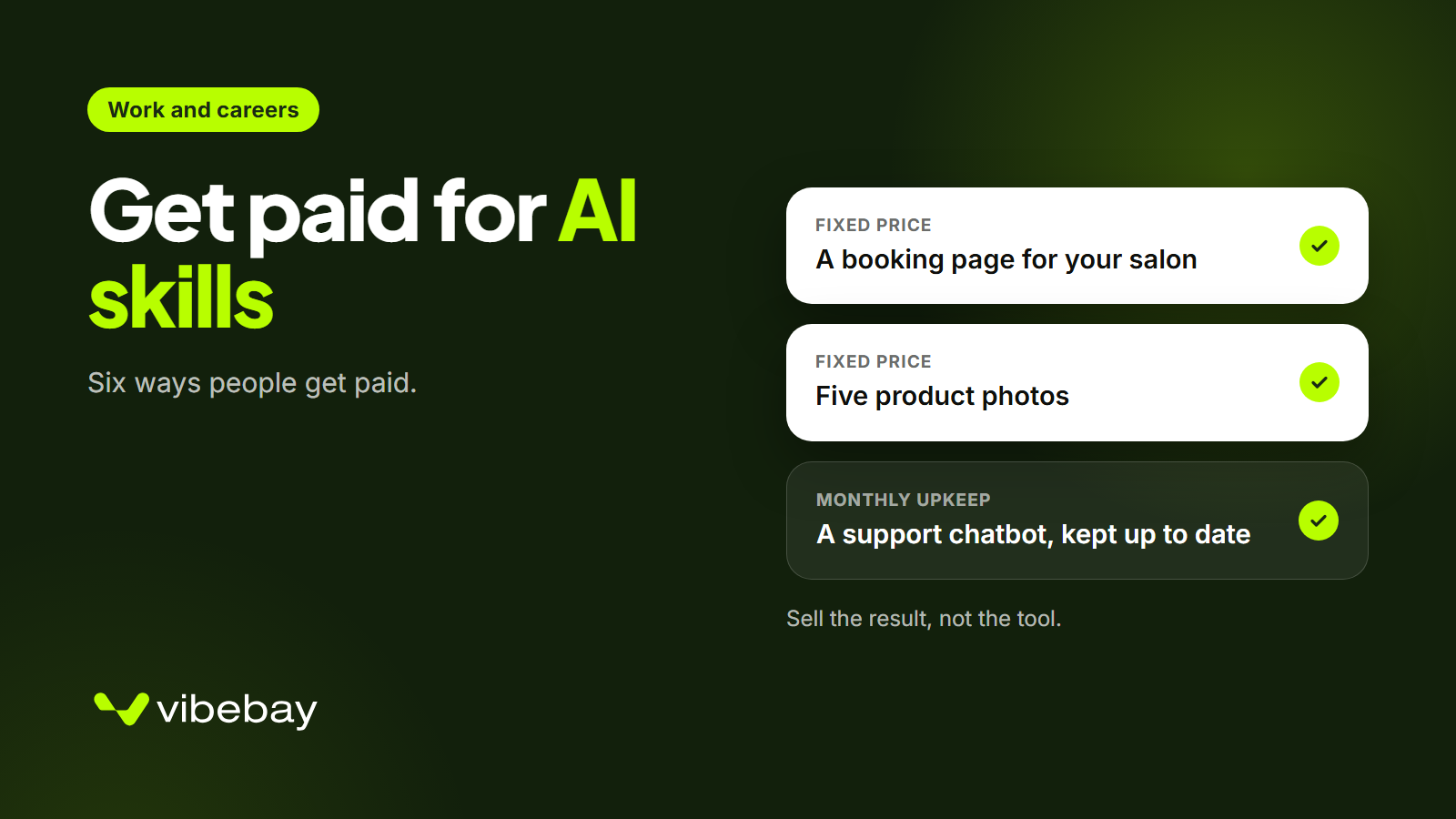
A bakery owner does not want "a Midjourney expert". They want product photos that make people hungry. A coach does not want "an n8n workflow". They want new enquiries to land in their calendar without lifting a finger.
Keep that in mind for everything below. The clearer the result, the easier you are to hire.
1. Fixed-price services
What it is: one clear piece of work for one clear price. "Five product photos for $80." "A booking page for your salon for $300."
Who it suits: people who do one kind of work well and can repeat it.
First client: build three samples for imaginary but realistic customers. Show those. Nobody needs to see a famous logo, they need to see that you can do the thing.
Common mistake: a vague offer. "AI services" tells a buyer nothing. Name the result, what is included, and how long it takes.
2. Replying to job posts
What it is: a client describes what they need, and you send a proposal.
Who it suits: people who are good at reading a brief and explaining how they would solve it.
First client: answer the brief, not your CV. Open with what you understood, show one sample that is close to what they asked for, and give a price and a date.
Common mistake: sending the same proposal to everyone. Clients can tell in one line.
3. Remote jobs with companies
What it is: contract or part-time roles such as evaluating AI answers, editing AI video, writing prompts or testing models. You apply to the company and they pay you directly.
Who it suits: people who want steadier hours and are happy to work to someone else's process.
First client: you need a tidy resume and proof of care. Much of this work is about accuracy, so a clean, error-free application is the first test. Our remote AI jobs board lists open roles.
Common mistake: treating it as easy money. The pay reflects attention to detail, and sloppy work gets you dropped quickly.
4. Upkeep and retainers
What it is: a monthly fee to keep something running. The chatbot you built needs new answers. The automation breaks when a tool changes. The site needs small edits.
Who it suits: anyone who has finished a project for a happy client.
First client: the one you just delivered for. Offer it on the day you hand the work over: "For a set amount a month I will keep this working and make small changes."
Common mistake: no limits. Say how many hours or requests the fee covers, or it will swallow your month.
5. Teaching
What it is: workshops, one-to-one sessions or short courses on how to use AI tools for a specific job.
Who it suits: patient people who explain well. You do not need to be the world's leading expert, only a few steps ahead of the person you are teaching.
First client: teach one narrow thing to one kind of person. "ChatGPT for estate agents" is easier to sell than "AI for everyone".
Common mistake: teaching the tool instead of the job. People want to write listings faster, not to understand how the model works.
6. Templates and small products
What it is: something you make once and sell many times. A prompt pack for a profession, an automation template, a starter app.
Who it suits: people who have already done the same job several times and can see the pattern.
First client: this is the slowest route to a first sale, because you need an audience. It works best as an add-on once the routes above have brought you customers.
Common mistake: starting here. Without customers you are guessing what they want.
How to price
Price by what the result is worth, not by how long it takes you. AI makes you fast. If you charge by the hour, you are punished for being good.
- Start with the result. What does the client get, and what would it cost them to do without it?
- Look at three similar offers. You do not need to be the cheapest. You need to be clear about what is included.
- Set a floor. Decide the lowest price that is worth your time, and do not go under it.
- Put limits in writing. How many revisions, what counts as extra, when it is due.
- Raise it as you fill up. If everyone says yes at once, the price is too low.
What you need before anyone pays you
- Samples. Three good ones beat thirty average ones. Say what the brief was and what you delivered.
- A plain description. One sentence a stranger understands. "I build booking sites for small studios."
- A reply within a day. Speed wins more work than talent does.
- A safe way to get paid. Agree the price and the scope before you start, and do not hand over finished work on a promise.
Where VibeBay fits
VibeBay is a marketplace built only for AI work. Talent list fixed-price services called Vibes, reply to client job posts on Find work, and can apply to outside roles on the jobs board.
The client pays before work starts and the money is held until they approve, so you are not chasing invoices. Talent keep 85 to 90 percent of each order, depending on their level. Every profile is reviewed by our team before it goes live. You can join as talent for free.
Pick one and start
Do not try all six. Choose the one that fits how you like to work, make three samples this week, and put a clear offer in front of real people. Paid work in AI goes to those who show finished results, not to those who know the most tools.
Want to see what others are making? The community has showcases of finished work from AI talent.