Life
How to stay focused when you work from home: 9 habits that hold up
Home has no bell, no boss walking past and a fridge ten steps away. Nine simple habits that make it easier to start, keep going and stop on time.
By VibeBay team4 min read
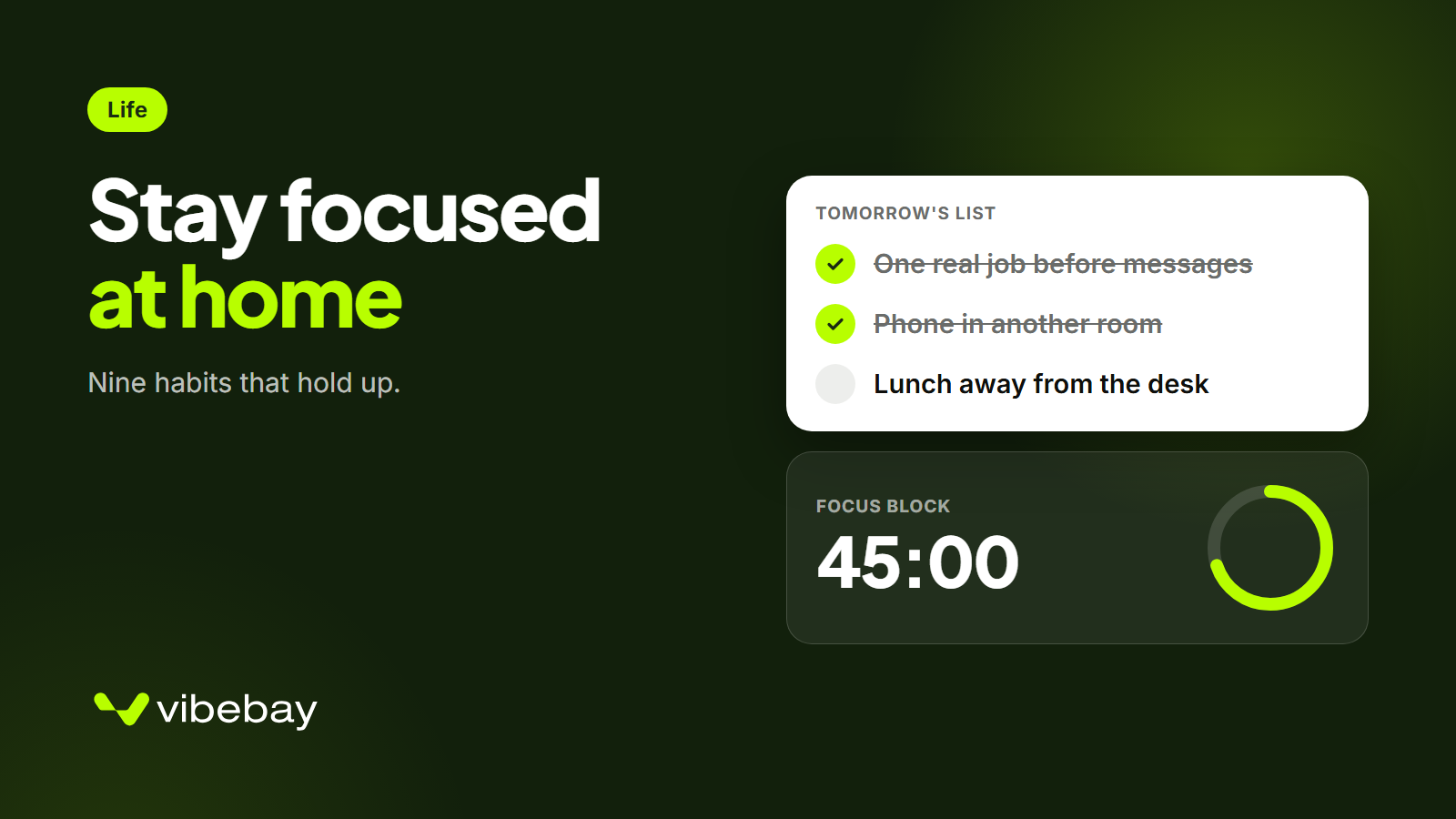
Working from home sounds easy until you try it. No commute, no dress code, no open-plan noise. Also no start time, no finish time, and a pile of laundry looking at you.
Offices do a lot of invisible work. They tell you when the day begins, they keep you around other people who are working, and they send you home at night. At home you have to build those signals yourself.
These nine habits are not clever. They are the ones that still work on a bad Wednesday.
1. Start at the same time every day
Your brain likes a cue. Pick a start time and keep it, even when nobody is checking. It does not have to be early. It has to be the same.
Add a small ritual before it: make a coffee, walk around the block, open the same playlist. After a week or two, the ritual does the starting for you.
2. Do one real thing before you open messages
Email and chat feel like work, but they are mostly other people's priorities. If you open them first, the morning is gone before you have done anything of your own.
Choose the one job that matters most today and give it the first 45 to 60 minutes. Messages will still be there. Almost nothing is so urgent that it cannot wait an hour.
3. Put your phone in another room
Not face down on the desk. Not on silent beside you. In another room.
A phone you can see pulls at your attention even when it does nothing. Distance is the only setting that works. If you need it for calls, turn the ringer on and leave it where you have to stand up to reach it.
4. Give work one place
It does not need to be an office. A corner of a table is enough, as long as it is the same corner and you only work there.
Try not to work from bed or the sofa. When every spot in your home is a workplace, no spot feels like rest.
5. Write tomorrow's list tonight
Before you stop, write down the three things you will do tomorrow, in order. Three, not twelve.
In the morning you do not have to decide anything. You sit down and begin number one. Deciding what to do is often harder than doing it, so make the decision when you are not tired of the day yet.
6. Work in blocks, with real breaks
Nobody concentrates for eight hours. Most people manage good focus in stretches of 45 to 90 minutes.
Set a timer, work on one thing until it rings, then get up. Stand, stretch, look out of a window, drink some water. Scrolling your phone is not a break. It is more screen.
7. Eat lunch away from the desk
Lunch at the keyboard saves no time. You eat slower, work slower, and feel like the day never paused.
Take twenty minutes somewhere else. If you can, go outside. The afternoon version of you will be noticeably sharper.
8. Tell the people you live with
Family and housemates cannot see whether you are "at work". A simple signal helps everyone: a closed door, headphones on, or a note that says when you are free.
Agree it once, kindly, instead of getting annoyed every time someone asks a quick question.
9. End the day on purpose
At home, work can leak into the whole evening. Give the day a clear end.
Write tomorrow's list, close the laptop, and put it out of sight if you can. Then do something that marks the change: a walk, cooking, a shower, anything that is plainly not work. A day with an ending is easier to start again tomorrow.
What to do on a bad day
Some days none of this works. You sit down and nothing happens. That is normal, and it is not a character flaw.
- Shrink the job. Do not "write the report". Write the first paragraph. Often that is enough to get moving.
- Change the place. A library, a cafe or a different room can reset your head.
- Do the easy jobs. Clear the small things you have been putting off. A day of small wins still counts.
- Stop early. If the day is truly gone, end it and rest. Two bad hours are not worth a ruined evening.
If the bad days outnumber the good ones for weeks, that is worth taking seriously. Talk to someone you trust or to a doctor. Habits help with focus. They are not a fix for exhaustion.
Start with two
Do not adopt all nine tomorrow. Pick two that sound doable. For most people the biggest change comes from the fixed start time and the phone in another room.
Give them two weeks. Then add a third.
How do you stay on track at home? Start a discussion in our community and tell us what works for you. It does not have to be about AI. For more on working life, see the rest of the blog.