AI and tech
What is vibe coding?
Vibe coding means building software by describing what you want to an AI tool. Here is how it works, what it is good at, where it breaks, and how to start.
By VibeBay team4 min read
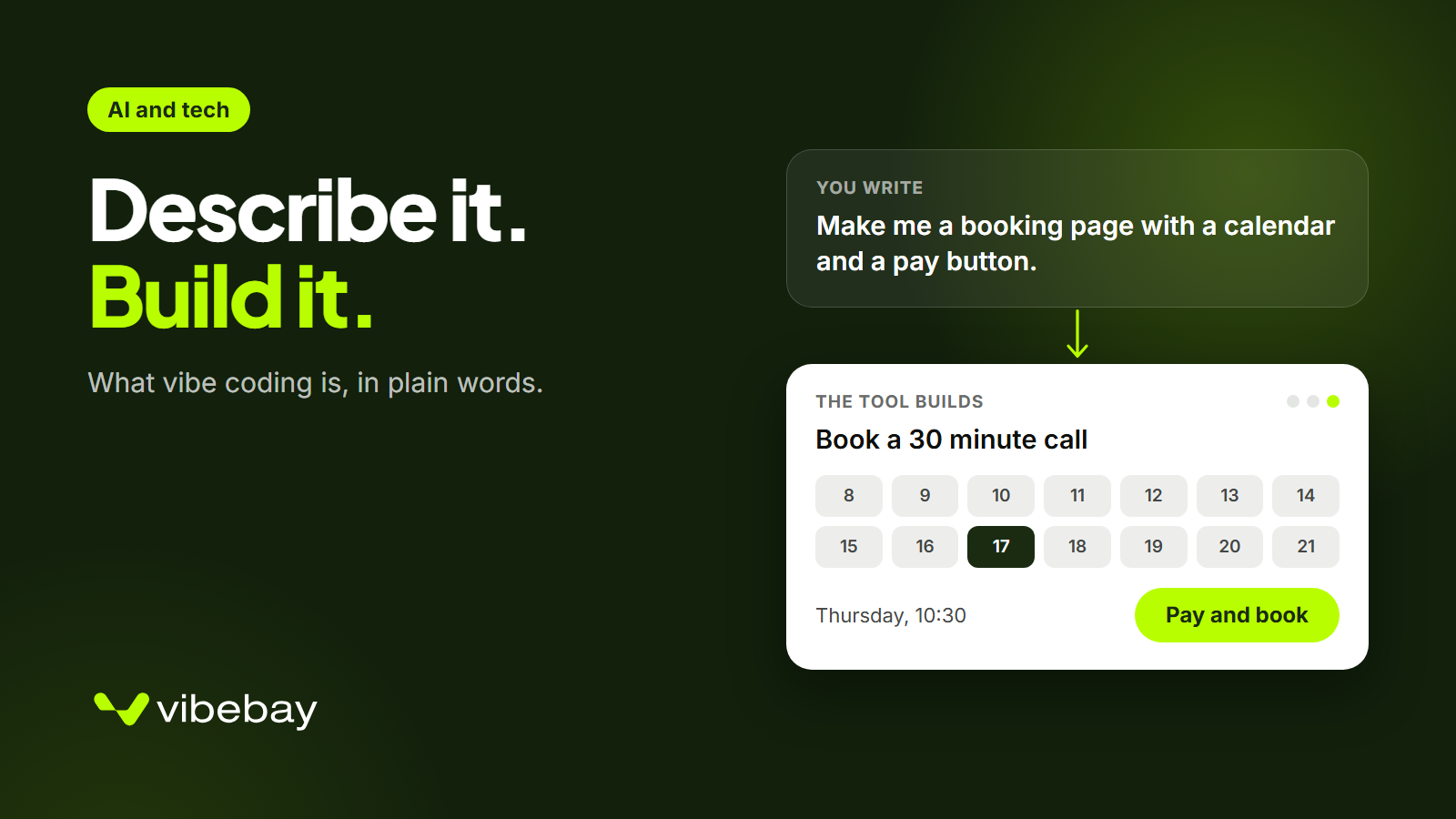
Vibe coding is building software by describing what you want in plain words and letting an AI tool write the code. You say "make me a booking page with a calendar and a pay button". The tool builds it. You look at the result, say what is wrong, and it tries again.
The person doing it may never read the code. That is the "vibe" part: you steer by how the app looks and behaves, not by what is written underneath.
Where the term came from
The AI researcher Andrej Karpathy named it in February 2025. He described a way of working where you "fully give in to the vibes" and stop thinking about the code at all. The name stuck because it described something thousands of people were already doing.
How it works in practice
Most vibe coding follows the same loop:
- Describe. Write what you want, the way you would explain it to a person. Who uses it, what they do, what they should see.
- Run. The tool writes the code and shows you a working version, often in under a minute.
- Check. Click through it like a customer would. Does the button work? Is the price right? What happens with an empty form?
- Correct. Tell the tool what is off. "The total ignores the discount." "Move the calendar above the form."
- Repeat until it does the job.
The skill is not typing code. It is describing clearly, testing honestly, and noticing when something is wrong.
The tools people use
There are two broad kinds.
Builders that run in your browser. Lovable, Bolt, v0 and Replit let you describe an app and get a working site without installing anything. They are the easiest place to start.
Tools that work inside a code project. Cursor is a code editor with AI built in. Claude Code works from the command line across a whole project. They ask for a little more setup and give you more control.
You do not need to pick the "best" one. Pick one, build something small, and you will learn what matters to you.
What vibe coding is good at
- Prototypes. A clickable version of an idea in an afternoon, to show a customer or a partner.
- Small tools for one job. A quote calculator, a sign-up form, a simple dashboard.
- Internal tools. Something five people in your business use, where a rough edge is fine.
- Landing pages and simple sites. A page that explains what you sell and takes an enquiry.
- Learning. You can ask the tool to explain what it wrote, line by line.
Where it breaks
Vibe coding gets you to "it works on my screen" very fast. The trouble starts after that.
- Security. The tool may leave data open to anyone who knows the address, or store a password in plain text. It will not always tell you.
- Payments and personal data. Mistakes here cost real money and can break the law. They need someone who knows what to check.
- Growth. An app that is fine for 20 users can fall over at 2,000.
- Changes later. If nobody understands the code, every fix is a gamble. One change quietly breaks another.
- The last ten percent. Edge cases, error messages, slow phones, odd browsers. This part still takes care and time.
A rule of thumb: if a mistake would only embarrass you, vibe code it. If a mistake would cost a customer money or expose their data, get it checked.
How to start this weekend
- Choose one small thing. Not "an app like the big ones". Something like "a page where customers book a 30 minute call".
- Write the brief first. Three or four sentences: who it is for, what they do, what done looks like. Our guide on what to automate first has examples of jobs that fit.
- Build it in a browser tool. Stay in one tool until it works.
- Test it like a stranger. Wrong inputs, empty fields, the back button, your phone.
- Show one real person. Watch them use it without helping. You will learn more in five minutes than in five hours alone.
When to hand it to someone experienced
Plenty of people now build this way for a living. They have shipped enough projects to know where the traps are, and they can take a rough version and make it safe to put in front of customers.
It is worth hiring one when:
- real customers will pay through it or sign in to it,
- you have a version that almost works and you are stuck,
- you would rather spend your week on your business than on bug fixes.
On VibeBay you can post a job in plain words and get proposals from vetted AI talent, or explore talent who build apps and sites this way. If you build this way yourself, you can join as talent and get paid for it.
The short version
Vibe coding lets almost anyone turn an idea into working software by describing it. It is fast, it is fun, and it is real. It is also not the whole job: the checking, the security and the upkeep still need a person who knows what to look for.